
On the sandy farms of Bikaner and the orchard belts of Bharatpur, a quiet question is taking shape: what if the trees a farmer plants, the crop residue she stops burning, and the soil she restores could earn her family a new, steady income — while helping the planet? That is the promise of carbon farming, and it is the foundation of a community-led carbon credit programme that Shree Guru Jambeshwar Sewa Sansthan (SGJSS) is now developing across two contrasting landscapes of Rajasthan.
Working since 2007 in environmental conservation, sustainable agriculture, women’s empowerment, and rural livelihoods, SGJSS is preparing one of its most ambitious initiatives yet: a carbon project designed not around plantations owned by companies, but around smallholder farmers and women’s self-help groups who own the trees, the practices, and the benefits.
What Are Carbon Credits?
A carbon credit is a certificate representing one tonne of carbon dioxide (CO₂) that has been removed from the atmosphere or prevented from entering it. When a farmer plants trees on her field, the growing trees absorb CO₂ and lock it into wood and soil. When crop residues are converted into biochar — a stable, charcoal-like material — instead of being burned, the carbon in that residue is stored in the soil for centuries.
Independent registries and auditors measure and verify this stored carbon. Once verified, each tonne becomes a credit that companies, institutions, and governments purchase to compensate for their own emissions. The payment flows back to the project — and, in a community-led model, to the farmers whose land and labour created the credit in the first place.
In simple terms: carbon credits turn good environmental practice into a measurable product that the world is willing to pay for.
Why Carbon Markets Matter for India and Rajasthan
India has committed to reaching net-zero emissions by 2070 and is building a domestic carbon market through the Carbon Credit Trading Scheme (CCTS), alongside long-established international voluntary standards. Nature-based solutions — agroforestry, soil carbon, and biochar among them — are widely recognised as some of the most cost-effective ways to remove carbon while delivering benefits on the ground.
Rajasthan has a particular stake in this. Our state is on the front line of climate stress: rising temperatures, erratic rainfall, and land degradation in arid and semi-arid regions directly threaten farming families. Yet the same geography holds enormous potential. Hardy, water-efficient tree systems suited to desert and semi-arid conditions can sequester carbon while stabilising soils and incomes. For a state where most rural households depend on agriculture and animal husbandry, carbon finance offers something rare: a way to fund climate adaptation that pays farmers rather than taxing them.
How Carbon Farming Can Benefit Smallholder Farmers
For a smallholder with two or three bighas of land, the mathematics of farming are unforgiving — one failed monsoon can erase a year’s effort. Carbon farming changes the equation in four ways.
First, it adds a new income stream. Verified carbon credits generate payments spread over many years, complementing seasonal crop income rather than replacing it. Second, it builds productive assets: fruit trees such as pomegranate, date palm, mango, guava, and amla begin yielding marketable produce within a few years, so the same trees that earn carbon revenue also fill baskets. Third, it restores the land itself. Biochar applied to fields improves water retention and soil fertility — a meaningful gain in districts where every millimetre of moisture counts. Fourth, it reduces harm: converting crop residues into biochar instead of burning them cuts air pollution and keeps nutrients in the village economy.
The result is a farm that is more diverse, more drought-resilient, and less dependent on any single crop or season.
SGJSS’s Vision: A Community-Led Carbon Project
Many carbon projects in the world treat farmers as suppliers of land. SGJSS’s vision inverts that model. Our project is being designed around three principles:
Community ownership. Farmers and women’s self-help groups (SHGs) are the project’s participants and primary beneficiaries, with transparent benefit-sharing agreed before the first sapling is planted.
Livelihoods first. Every intervention — tree species, biochar production, regenerative practice — is selected because it strengthens farm incomes on its own merits. Carbon revenue is designed as supplementary income, not the sole reason to participate.
Scientific integrity. The programme is being developed under internationally recognised carbon standards, with digital measurement, reporting, and verification (MRV), so that every credit issued reflects real, additional, and durable climate benefit.
This vision draws directly on SGJSS’s grassroots foundations. As a NABARD Project Implementing Agency, SGJSS has delivered livelihood and enterprise development programmes with SHG women and farmers across Bikaner, Bharatpur, and other districts — experience in exactly the kind of village-level mobilisation, training, and monitoring that a credible carbon project demands.
The Implementation Model: Two Landscapes, One Approach
The proposed programme focuses on two agro-climatic zones of Rajasthan.
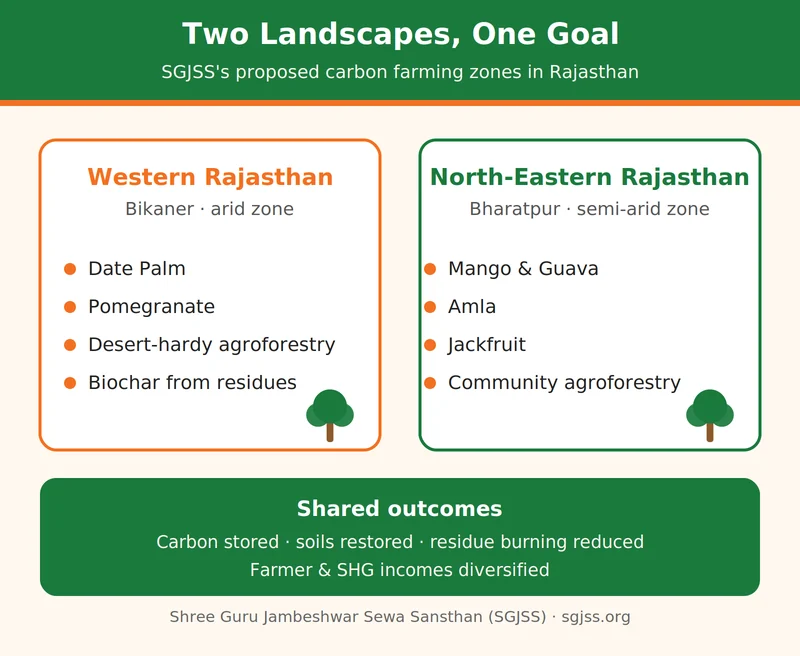
Western Rajasthan (Bikaner district). In the arid west, the project will promote water-efficient agroforestry built around date palm and pomegranate, alongside traditional desert-hardy species, together with biochar production from farm residues. These systems are chosen for their proven performance in low-rainfall conditions and their strong market demand.
North-Eastern Rajasthan (Bharatpur district). In the semi-arid east, community agroforestry will centre on mango, guava, amla, and jackfruit — orchard systems that suit the region’s soils and connect naturally to SGJSS’s ongoing farmer producer organisation and livestock development work in the district.
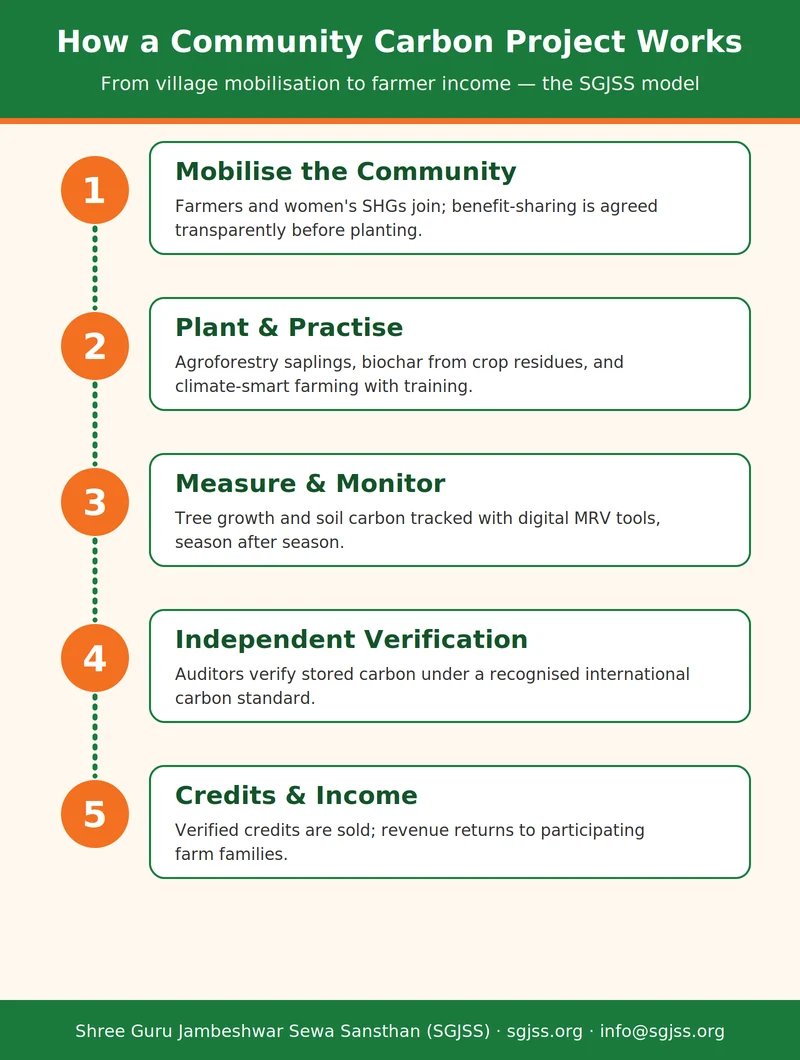
Across both zones, the model follows a clear sequence: mobilise farmers and SHGs and agree benefit-sharing; plant and adopt climate-smart practices with training and quality saplings; measure and monitor growth and soil carbon through digital MRV tools; verify with independent auditors under a recognised carbon standard; and finally issue and sell credits, returning revenue to participating families. Local technical institutions and agricultural research partners will support species selection, training, and monitoring throughout.
Expected Impacts
Environmental. Thousands of multi-purpose trees established on farmland; measurable carbon sequestered in biomass and soil; reduced residue burning; improved soil health and moisture retention; and richer on-farm biodiversity in both landscapes.
Social. Skills and confidence for farming families — especially women, who anchor SGJSS’s SHG networks — in nursery raising, orchard management, biochar production, and record-keeping; stronger community institutions capable of managing long-term collective assets.
Economic. Diversified household income combining fruit sales, improved yields, and carbon payments; new village-level micro-enterprises around biochar and nursery production; and a demonstrable model that can attract further climate finance to Rajasthan’s villages.
Challenges and Opportunities
We are candid about the challenges. Carbon projects demand patience: trees take years to grow, and verification standards rightly require rigorous, multi-year monitoring before credits are issued. Upfront costs — saplings, training, MRV systems, certification — must be financed before carbon revenue flows. Farmers need honest communication so that expectations match the realistic timeline of carbon income. And in arid regions, every plantation must be designed around water availability.
Each challenge, however, is matched by an opportunity. India’s carbon market is expanding, and demand for high-integrity, community-based nature credits is growing faster than supply. Rajasthan’s underutilised drylands are precisely where new carbon removal can be created without competing with food production. And SGJSS’s nearly two decades of village-level presence provide what most carbon developers lack: the trust of the communities themselves.
How Partners Can Collaborate With SGJSS
Building a high-integrity carbon programme is a collective effort, and SGJSS invites collaboration across the ecosystem. Government agencies and development institutions can align the project with agroforestry, watershed, and rural livelihood missions. CSR partners and impact investors can finance the critical early phase — nurseries, training, and MRV systems — and associate their brand with verified, farmer-first climate action in India. Technical partners, research institutions, and carbon market specialists can strengthen methodology, species science, and credit certification. Donors and individual supporters can help us reach more villages, more women, and more farmers.
Prospective partners and carbon buyers can review SGJSS’s full statutory registrations, approvals, and audit credentials on our Trust & Compliance page.
Partner with SGJSS to Build Climate-Resilient Communities Through Carbon Finance
SGJSS is now seeking early-stage partners — CSR funders, philanthropic donors, technical collaborators, and government programmes — to co-create Rajasthan’s community-led carbon farming model. Your support at this foundation stage will determine how many families the programme can reach in its first phase. To explore partnership, write to us at info@sgjss.org, call +91-9414334192, or visit our Contact Us page. To support our wider environmental and livelihood work today, visit Donate Now.
Together, we can make Rajasthan’s farms a frontline of climate action — and ensure the rewards reach the hands that plant the trees.